Recovery isn't rescue: 6 tools and the order that keeps everyone safe when your 4x4 is stuck
 Save
Getting stuck in soft ground, deep ruts or mud is not a failure of planning—it is part of overland travel. How you recover a stuck vehicle determines whether you drive away in minutes or spend hours making the problem worse. The difference lies in method: assessing what has trapped the wheels, choosing the right tool for the load, and working through a sequence that protects the vehicle, the equipment and the people around it. Cox Morgan Overland walks through the tools, the order and the mistakes that turn a simple recovery into something more serious.
What has actually stuck the vehicle
Before touching a strap or a shovel, walk around the vehicle and look at each wheel. One wheel spinning in a hole is different from all four wheels sitting on their chassis in deep mud, and the tool that frees one will not work for the other. Check the ground under the axles: if the differentials are resting on a rock or a ridge of hardened mud, lifting the vehicle even slightly will let the wheels turn again.
Look behind the vehicle at the track you have made. If the ruts are deep and the underside has been dragging, the resistance is friction along the length of the chassis, not just at the wheels. Look ahead at the ground you were trying to cross: if it slopes upward or the surface changes from firm to soft, momentum was lost and the vehicle simply stopped moving forward. Knowing what stopped the vehicle tells you whether to dig, to lift, to winch, or to reverse out the way you came in.
Reverse first, and why it works more often than forward
The first attempt at any recovery is to reverse along the track you made coming in. The ground behind you has already been compressed by the weight of the vehicle once, so it is firmer than untouched ground ahead. Reverse slowly in the highest gear the engine will pull without stalling, and do not spin the wheels: spinning digs the tyres deeper and turns firm ground into soup.
If reverse gains even half a metre, stop, select forward again and try to build momentum before you reach the point where the vehicle stuck the first time. Two or three attempts at this may be enough to carry you through. If reverse does not move the vehicle at all, stop immediately. Continuing to spin the wheels heats the clutch, buries the tyres and makes every other method harder.
The six tools every overland vehicle should carry for recovery
Most recoveries are resolved with one or two simple tools, used in the right order. Carrying the following and knowing what each does will cover almost every situation short of structural damage.
- A shovel—not a folding camping trowel, but a full-length spade with a steel blade. Clearing mud from around the wheels and levelling the ground ahead often makes the difference between moving and staying stuck.
- A high-lift jack—mechanical, not hydraulic. Used to lift one corner of the vehicle so you can pack stones or logs under a wheel, or to pull the vehicle sideways when a winch point is not ahead.
- Recovery straps—textile straps rated for the vehicle's weight, with loops at each end. Never use a tow rope or a ratchet strap for recovery: they are not designed for the load.
- A snatch strap—a recovery strap with stretch built in, used for kinetic recovery when one vehicle pulls another out using momentum. Requires training to use safely.
- A winch—electric or hand-operated, mounted to the front or rear of the vehicle. The single most versatile recovery tool, but also the one that causes the most injuries when used incorrectly.
- A snatch block—a pulley that doubles the pulling power of a winch or changes the direction of pull. Small, inexpensive, and transforms what a winch can do.
Shackles, tree protectors and gloves belong with these tools, and none of them works if left at home because they add weight. The weight is the point.
Reducing the load and clearing the path
If reverse has not worked and the vehicle is deeply stuck, remove weight before attempting a pull. Passengers step out and wait uphill and to the side, never downhill or in line with a strap. Heavy items in the back—water, fuel, camping equipment—come out if the ground is firm enough to carry them. Even removing a hundred kilograms makes a difference to how much force is needed.
Clear the ground ahead of each wheel for at least two metres: dig out mud, remove rocks, fill ruts with stones or logs. Create a shallow ramp leading out of any hole the tyre has made. If the vehicle is sitting on its axles, dig under the differentials until there is clearance. This work takes longer than it should and feels futile while you are doing it, but it prevents damage and often removes the need for a second vehicle entirely.
Winching: the method that works when nothing else will
A winch pulls the vehicle toward a fixed anchor point—a tree, a buried object, or another vehicle. It is slow, controlled, and does not rely on momentum. Before winching, check the anchor: a living tree needs a tree protector around its trunk, and the tree must be thick enough to take the load without moving. Test the anchor by hand before connecting the cable.
Attach the winch hook to the anchor or to a strap around it, never directly to the tree with a bare hook. Run the cable out straight, with no kinks or loops. Someone stands beside the vehicle with a hand on the winch control—never in front of the vehicle, never in line with the cable. If the cable snaps, it will recoil in the direction of the load, and steel cable under tension cuts through anything in its path.
Winch slowly, stopping every few metres to check the cable and the anchor. If the vehicle is not moving, stop winching: forcing it will overheat the winch motor or break the cable. Instead, use a snatch block to double the pulling power or change the angle of pull, or dig and clear more ground. Winching should feel boring. If it feels dramatic, something is wrong.
When a second vehicle is pulling: the difference between a tow and a snatch
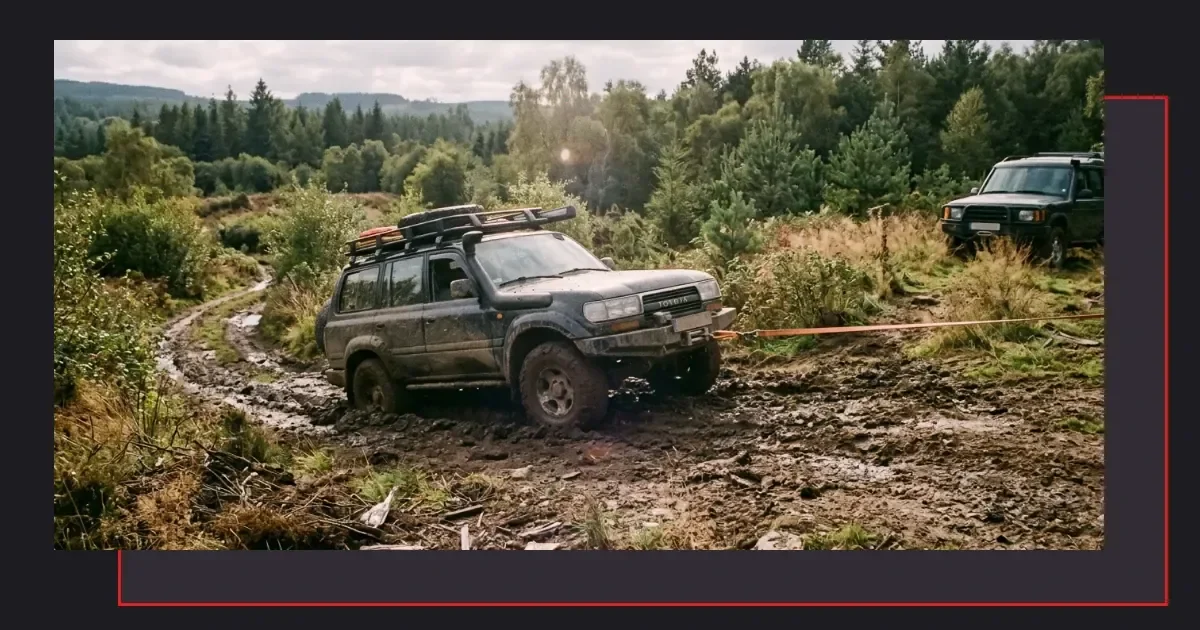
A second vehicle can pull a stuck vehicle out in two ways: a static tow, where the strap stays tight and the pulling vehicle moves slowly, or a kinetic recovery, where the pulling vehicle uses momentum and the strap stretches. The first is safer and should always be tried first. The second is faster but has more ways to go wrong.
For a static tow, connect the recovery strap between the tow points of both vehicles—never to a tow ball, a bumper or anything that might shear off under load. The pulling vehicle moves forward slowly in low range, keeping the strap tight. The stuck vehicle should be in gear with the engine running, ready to drive as soon as the wheels gain traction. If the stuck vehicle does not move after ten metres of pull, stop: a longer pull will not help, and it risks overheating the pulling vehicle's clutch.
A kinetic recovery uses a snatch strap, which stretches and stores energy as the pulling vehicle accelerates. This method generates much more force and can free a vehicle that a static tow cannot budge, but it also generates much more danger. Both drivers must understand the technique before attempting it. The pulling vehicle accelerates gently until the strap goes tight, then the stretch does the work. If the strap breaks or a shackle fails, the stored energy is released in an instant. Never use a kinetic recovery unless a static tow has failed and both drivers have done this before.
The four mistakes that make a simple recovery dangerous
- Standing in line with a strap or cable under tension. If it breaks, it will recoil toward the anchor point or the vehicle, and there is no time to step aside. Everyone stays to the side, well clear, until the recovery is complete.
- Using the wrong attachment point. Tow balls, bumper mounts and roof racks are not recovery points. The vehicle's chassis has designated points, often marked, and using anything else can tear the metalwork off or cause the strap to slip.
- Accelerating hard to "bounce" the vehicle out. Spinning wheels dig deeper, throw mud, and overheat the clutch and the engine. Momentum is built gradually, and only after the ground has been cleared.
- Continuing when something does not feel right. If the cable is fraying, if the anchor tree is bending, if the engine is overheating, stop. Every serious injury in a recovery happens because someone ignored a warning and kept going.
Comparing recovery methods: what each one asks of you
| Method | What it needs | When it works | What it risks |
|---|---|---|---|
| Reverse out | Nothing but the vehicle | Light bog, early intervention | Clutch slip if wheels spin |
| Dig and clear | Shovel, stones or logs | Chassis on ground, ruts | Time and effort |
| Winch | Anchor point, winch, cable | Deep mud, no second vehicle | Cable snap, anchor failure |
| Static tow | Second vehicle, recovery strap | Most situations | Clutch heat, shear at weak points |
| Kinetic recovery | Second vehicle, snatch strap, training | When static tow has failed | Strap or shackle failure, recoil |
What to check after the vehicle is free
Once the vehicle is back on firm ground, stop and inspect it before driving on. Walk around and check for mud packed into the wheel arches, the underside and the radiator grille: thick mud reduces cooling and adds weight. Check the tyres for cuts, bulges or stones wedged into the tread. Look under the vehicle for fluid leaks—oil, coolant, brake fluid—that would indicate damage from a rock or a hard impact.
Check the recovery equipment before packing it away: straps for fraying or cuts, shackles for cracks or bent pins, winch cable for kinks or broken strands. Equipment that has been loaded once is more likely to fail the second time if damage has gone unnoticed. If anything looks questionable, replace it at the next town. The cost is small measured against the alternative.
Download PDF: Vehicle recovery safety checklist PDF, 30 KB
Further reading
Frequently asked questions
How much force does a recovery strap need to be rated for?
A recovery strap should be rated for at least the gross vehicle weight of the stuck vehicle, and preferably higher. Most overland vehicles weigh between two and three tonnes when loaded, so a strap rated for four tonnes gives a margin. The rating is usually printed on the strap itself or on a sewn label.
What is the difference between a snatch strap and a tow strap?
A tow strap has no stretch and is used for static towing on firm ground. A snatch strap is designed to stretch and store energy during a kinetic recovery, where the pulling vehicle uses momentum. Using a tow strap for a snatch recovery can cause it to snap, because it is not built to absorb the force.
Can you winch without a tree or another vehicle nearby?
Yes, by burying a ground anchor—often called a deadman—such as a spare wheel, a log or a purpose-made anchor plate. Dig a trench, bury the anchor deep, attach the winch cable to it and backfill the trench. It works in sand and soft ground where there is nothing else to pull against.